Galaksija
Built February – March 2025 · English build guide in progress
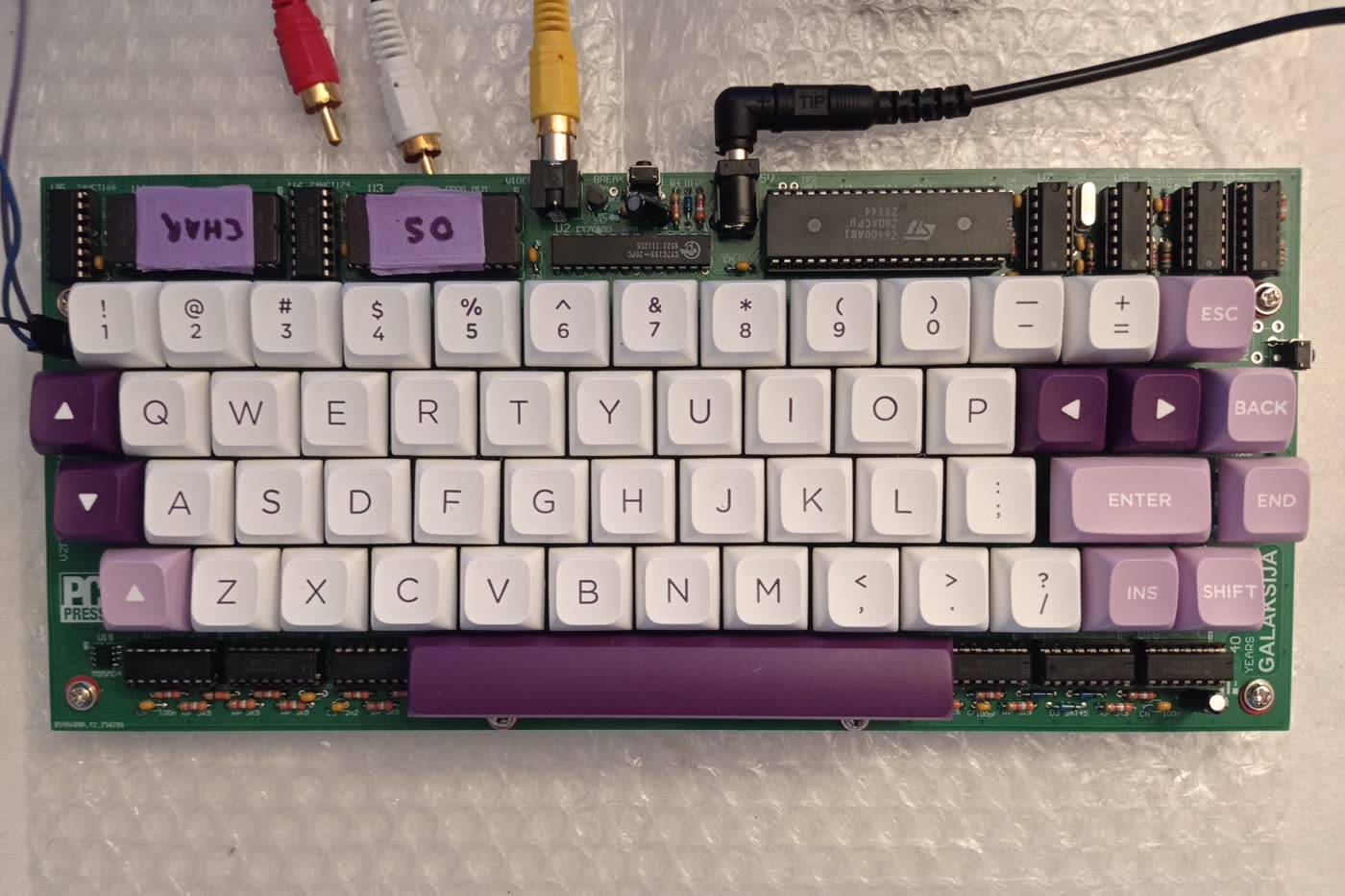
I built the 40th anniversary edition of the Galaksija, a Yugoslav 8-bit home computer from 1983. I sourced the parts myself, had the PCB made and soldered it together, and I'm now translating its Serbian assembly guide into English.
- Built
- February – March 2025
- Hardware
- Zilog Z80A CPU, 4 KB ROM, 2–6 KB RAM, Texas Instruments logic chips, Cherry MX-compatible switches
- Skills
- Through-hole and SMD soldering, EPROM programming, UART serial, BASIC, Serbian–English translation
- Links
- English build guide · Demo video · GitHub
Background
The Galaksija was designed in 1983 by Voja Antonić in Belgrade, inspired by home computers of the time like the ZX Spectrum. Yugoslavia had a 50 Deutsche Mark limit on imports, so complete computers couldn't be brought into the country. Instead, the Galaksija was published as a build-it-yourself project: an article by Dejan Ristanović in Računari u vašoj kući ("Computers in your home"), a special edition of Galaksija magazine, included the schematics, parts list, an assembly guide and programs.
The first 30,000 copies sold out quickly, and after four reprints more than 120,000 had been sold. 8,000 people ordered a kit, and Elektronik Inženjering later built the computer for government agencies and universities.
A large community grew up writing software for it, and some of that software was broadcast over the radio. Zoran Modli's show Ventilator 202 on Radio Beograd broadcast more than 150 programs over three years. The Galaksija loaded programs from cassette tape, so listeners recorded the broadcasts onto cassette and played them back into the computer.
The hardware
The original Galaksija has a Zilog Z80A CPU, 4 KB of ROM and between 2 and 6 KB of RAM. The 40th anniversary edition uses the same parts, with three changes: a modern EEPROM chip, a UART serial connection in place of cassette tapes for loading programs, and Cherry MX-compatible key switches.
Most of the parts are still mass-produced, so I ordered the majority from Digikey. I had the PCB made by JLCPCB from the free Gerber files on racunari.com. Jameco Electronics in the US was the only distributor I could find with new Z80 chips, the EPROMs and RAM came from an eBay seller in Germany, and the switches and keycaps, which are standard Cherry MX parts, came from Amazon.
The build
I started during the February mid-term break, beginning with the parts that sit lowest on the board: the resistors and capacitors, along with the power and video connectors. Next came the chip sockets and the Texas Instruments logic chips.
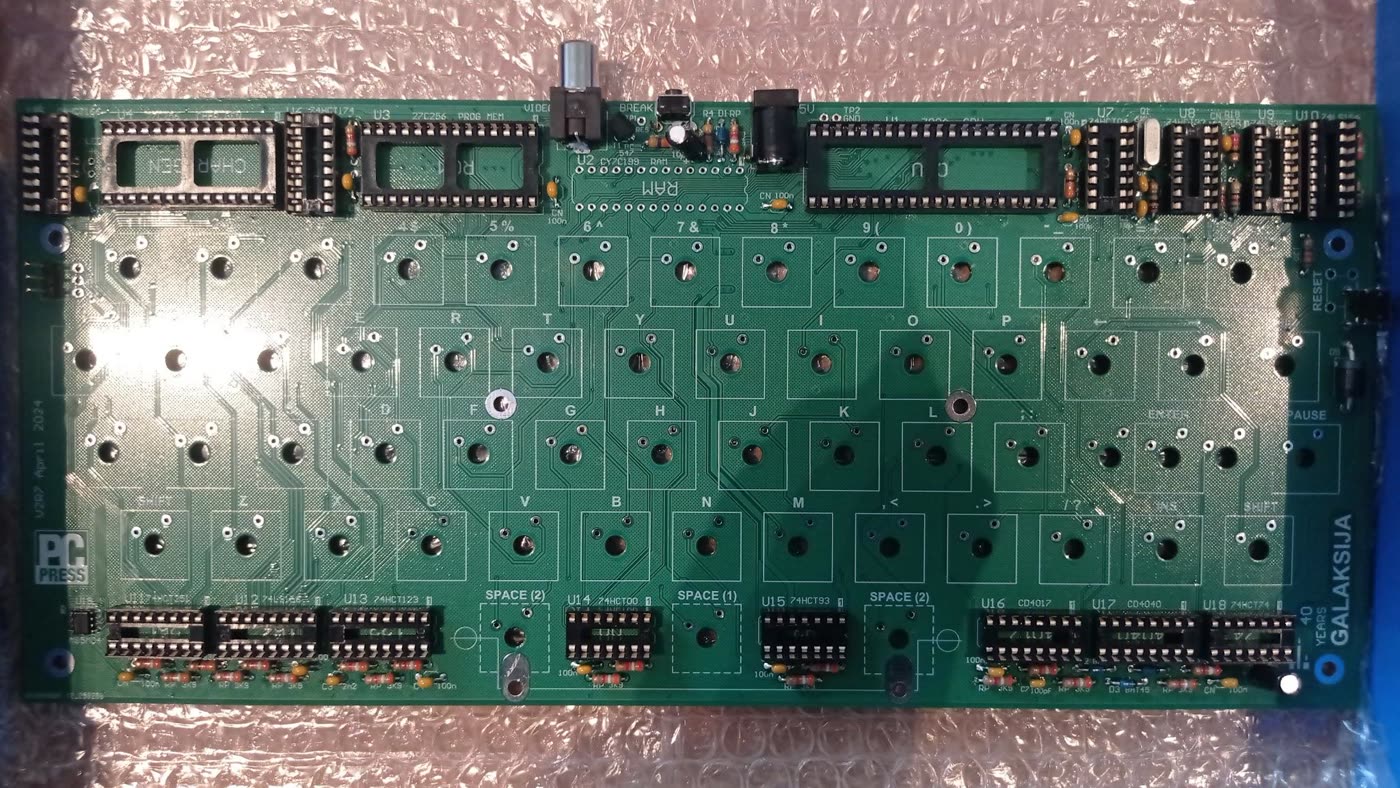
The CPU took a few weeks to arrive. When it did, it went in along with the ROMs and RAM. The two EPROMs are AM27C256 chips, one for the operating system and one for the character set. I programmed them with an XGecu T48 programmer, using its software and the image files from racunari.com. EPROMs are erased by UV light through a window on top of the chip, so I taped over both windows to protect them.
The last parts were the key switches and keycaps, and that Amazon order got lost. It only turned up the week of the project deadline, so I soldered the switches on the Wednesday and powered the computer up for the first time on the Thursday afternoon.
Loading programs over UART
Once it powered up, I set up the software to send game files to the Galaksija over UART. I first tried a Mac, but macOS uses a different serial driver, and the Python transfer script wouldn't run without heavy changes, so I moved to a Windows PC.
Even then, nothing got through at first. I'd wired the UART converter's RX pin to the Galaksija's RX, and TX to TX. A serial link needs them crossed, so that each side's TX goes to the other's RX.
After the build
Once it worked, I ported some BASIC games to Galaksija BASIC. The computer stayed at the Blanchardstown Foróige Clubhouse, which made the project possible, for members to use for programming and games.
Translating the build guide
The official assembly guide is only available in Serbian. As a native speaker, I'm translating it into English so builders outside the region can use it, and publishing it as a website.
The translation follows the original closely, but adapts the wordplay and colloquial terms that only work in Serbian. Where Serbian and English names differ, translator's notes explain them: what's sold in Serbia as "solder paste" is called flux in English, for example. The guide covers soldering technique, the order to fit components, connecting a monitor, the keyboard and space bar stabiliser, the case and power.